




































Grab the red pen and start praying. March is here, and the start of the March Madness Season is on its way. The 2026 Men’s National Collegiate Athletic Association (NCAA) Tournament runs from March 15 to April 6, starting with Selection Sunday and ending in the Final Four at Lucas Oil Stadium in Indianapolis on April 4 and 6. Sixty-eight exceptional teams are competing in the tournament, including two teams from Ohio (Ohio State Buckeyes and Miami RedHawks). As the buzzer sounds in Indianapolis in April, 2026, the only certainty is that a reimagined, expanded field has officially shattered the traditional bracket, leaving behind a new generation of legends and a madness that truly knows no bounds.
Bracketology is the world’s most famous part of March Madness. While many enthusiasts treat it as a casual hobby, others view it as a high-stakes science, with private pools sometimes reaching staggering sums of $1 million to $10 million. Yet, math remains the ultimate gatekeeper. The odds of predicting a perfect bracket are 1 in 9.2 quintillion. To put that in perspective, it is statistically more likely to be struck by lightning while winning the lottery. In fact, in the entire history of the men’s or women’s NCAA tournaments, no verified perfect bracket has ever been recorded. As the Slash Blog highlights in its “Ultimate Guide to Predicting March Madness,” the shift from “gut feelings” to statistical modeling has transformed the game. Modern professionals now utilize complex datasets and real-time analytics to find
an edge, moving away from intuition and toward evidence.
One strategy is relying on historical data. Historical data highlights details like how the number one seed (one of the four best teams in the NCAA tournament) rarely loses in the first round, and there are, on average roughly twelve to thirteen upsets (when a lower-seeded team (underdog) defeats a high-seeded team(favorite) per tournament. It also provides insight into how specific teams have historically fared in the tournament, enabling more educated decisions on where to place upsets. However, while trends suggest which teams should win, relying only on them can be risky. Effective brackets often combine historical data with current season analytics for a nuanced approach.
The history of March Madness is a story of a small scale experiment that evolved into a multi-billion dollar cultural juggernaut. While the tournament itself began in 1939, the “madness” known today was shaped by legal battles, television deals, and a slow shift from the elite-only era to the inclusive chaos of the modern bracket.
In the early days, the NCAA Tournament was actually the “little brother” of college basketball. The National Invitation Tournament (NIT), founded in 1938 and based at Madison Square Garden, was considered the premier event. In 1939, the first NCAA final saw Oregon defeat Ohio State 46–33 and t featured only eight teams. For years, many top teams actually preferred the NIT because it was played in New York City and offered more prestige. It wasn’t until the 1950s that the NCAA began to mandate that conference champions must play in the NCAA Tournament, slowly taking power away from the NIT.
(Lena Nguyen)
Surprisingly, the term “March Madness” was not originally about college basketball. In 1939, Henry V. Porter, an official with the Illinois High School Association, wrote an essay titled March Madness to describe the excitement of local high school tournaments. The term stayed in Illinois high school circles for over forty years until 1982. During a broadcast, CBS announcer Brent Musburger used the phrase to describe the NCAA tournament.This led to a trademark battle between the Illinois High School Association and the NCAA. Eventually, they formed a joint venture to share the name, but by 2012 the NCAA took full ownership of the trademark.
The tournament’s “modern era” is generally considered to have started in the late 70s and early 80s, when the structure shifted to create the possibility of the “Cinderella Story”. Before 1975 only one team per conference could enter. Expansion to 32 teams allowed for “at-large” bids (teams that didn’t win their conference but were still elite). 1979 was the first year of true seeding (1 through 16). Also, in 1985 The tournament expanded to sixty-four teams, creating the perfectly balanced four-region grid usen today. This was also the year number eight seed Villanova upset number one Georgetown, cementing the idea that anyone could win.
Every March Madness, there are always the top four seeds (the best four teams of the season), and for the 2026 March
Madness, there are intense feuds between them. The best seeds this year are Arizona, Duke, Iowa state, and Michigan and they are there for a season.
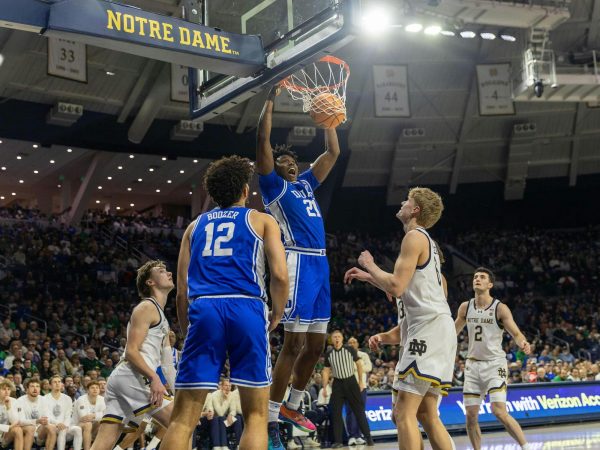
The Duke Blue Devils rely heavily on their elite team of freshmen, veterans, and a defense like no other. In fact, Duke’s main success is anchored by their elite defense. They are able to hold their opponent to under sixty points in seven out of their last eleven games. The Blue Devils have also built a powerful resume with several non-conference wins against the top twenty-five teams.
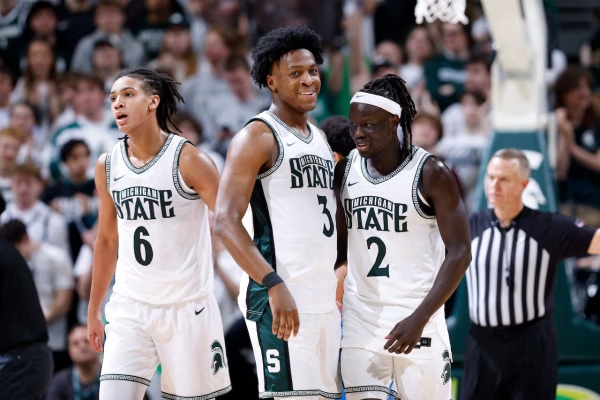
The Michigan Wolverines were recently ranked number one in the week of February 16, which was the first time in thirteen years. Yaxel Lendeborg, Michigan basketball player, leads the team that ranks top ten in both offensive and defensive efficiency. Michigan’s secret is a balanced attack and a deep roster. Four of their players have averaged double-digit scoring (a player scoring ten or more points in a single game). Those players include Lendeborg, Elliot Cadeau, Morez Johnson Jr, and Aday Mara all who are a part of Michigan’s basketball team.
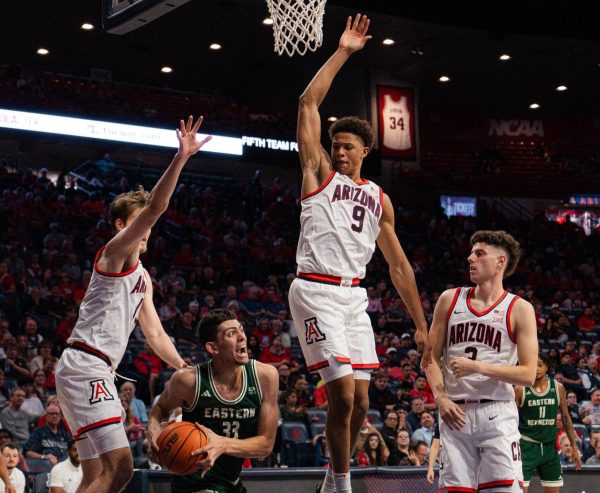
The Arizona Wildcats thrive in a physical conference by using a high-paced transition game. Their efficiency is just as impressive as the speed at which they play. Yahoo Sports, in its “Why are Duke, Michigan, Arizona, and ISU College Basketball’s best teams,” says shooting 50.4% from the field proves they create and finish high-quality shots.
Iowa State Cyclones, despite a tough loss recently to BYU, have a bright season ahead of them. Their success starts with the top-ten defense, along with the second-highest turnover margin in the Big 12. The Cyclones are a perfect 4-0 in games decided by five points or fewer. This team knows how to execute close contests.
By having Michigan, Duke, Arizona, and Iowa state as the top four overall seeds, the committee is almost certain that these four programs are clear nation championship contenders with each team proving that they can win through elite defense, electric scoring, and the ability to close out tight games.

Many heard about the “Cinderella” of March Madness, but don’t know what it is. The “Cinderella” of March Madness is a low-seeded underdog that defies expectations with an unexpected, deep run in the NCAA tournament, often reaching the Elite Eight or Final Four. Key factors include elite guard play, high-volume three-point shooting, strong defensive efficiency, and often, a favorable matchup against a higher seed.
Some underdog teams include the Tennessee Volunteers, who are considered a “nightmare” matchup due to their size and offensive rebounding. The Gonzaga Bulldogs, despite lowering rankings in strength of schedule, are well-coached and are expected to be a tough out this tournament. Finally, The Illinois Fighting Illini who are recognized for having a strong, albeit overlooked, roster.
With just over three weeks remaining until Selection Sunday on March 15, 2026, the college basketball landscape is hitting off with top contenders like Michigan, Duke, Arizona, and Iowa State positioning themselves for potential number one seeds. As conference tournaments approach the NCAA field is rapidly finalizing, promising to deliver the high-stakes drama and unpredictable upsets that define March. Whether it is the reigning champion Gators seeking a repeat or a surging underdog looking to disrupt the bracket, the road to the 2026 Final Four in Indianapolis is set for another unforgivable tournament.