




























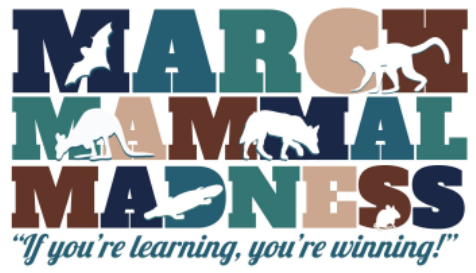










Every March, students and scientists around the world fill out brackets, but instead of debating basketball teams, they are predicting battles between animals to find out which one will reign at the top of the bracket. This is March Mammal Madness, a science-based tournament where species compete against each other in simulated encounters, and this year is no different.
March Mammal Madness was originally created by Katie Hinde, a biological anthropologist at Arizona State University in 2013. The idea was inspired by the excitement around the NCAA basketball tournament, but she wanted to use the competition to teach science.
March Mammal Madness is a 64- animal bracket where species “compete” in simulated encounters. Each of these 64 animals are sorted into categories based on similar features about them. This year, animals are sorted into the groups, “Library Legends”, “Money Mammals”, “Extinction is Forever”, and “That’s so Metal”.
The animals will be competing in 4 habitats, the ocean reef, swamp, desert, and eucalyptus forest, in which the lower seeded combatants have the home habitat advantage and the higher-seeded/worse player is the visiting opponent.
To win the round an animal must hold out their position in the match without withdrawing from the match. Withdrawing from the match, any fleeing, or carnage (a total knockout) are all counted as defeat of the species.
March Mammal Madness officially started March 9 with the wild card round. This year the wild card match is the bone collector caterpillar versus the Assassin bug. The wild card habitat is a complete coin flip upon the time of the encounter.
March Mammal Madness proves that learning science can be as exciting as watching a championship game, especially when the competition is full of claws, tusks, and survival shaped from millions of years worth of evolution.