





































Museums can often feel like spaces that require exclusive access, filled with valuable artwork and lavish halls that subtly determine who is welcome. However, the Cleveland Museum of Art defies that stereotype.
Located in University Circle, the museum provides free general admission to all guests, a policy that has defined the institution for over a century. Since its establishment in 1913, it has functioned on a mission “for the benefit of all the people forever,”. This becomes apparent from the moment one enters the building.

Vincent van Gogh
Location: 222 Impressionism & Post-Impressionism
Jennifer Williams, humanities teacher, thinks that the commitment to accessibility is what makes Cleveland so unique. “I think we are so lucky to live in Cleveland and have world-class museums and the orchestra,” she said. She goes on to say that the museum’s permanent collection includes “amazing and rare art including the Impressionist art, the knight armor room and Stargazer.” In addition to the permanent collection, she said that the museum “generally has rotating exhibits that focus on the area”.
According to The Cleveland Museum of Art’s website, visitors can view over 63,000 works of art that stretch 6,000 years of history. From Renaissance masterpieces and antiquities to Asian sculpture, modern photography, and contemporary art installations, all without paying an entrance fee. Williams emphasized how rare that has become among major institutions. “We are the last major museum to offer free entrance,” she explained. “Chicago and the Metropolitan are $25 or more unless a student is visiting who gets a discount.”
“I’d visited twice last year, once for a school field trip and once for fun, but I’d love to go more often!” said Alexis Soeder, a senior at BBHHS. “It’s very accessible with its free entry and a beautiful building. I love getting to spend time around the artwork and getting to share that with others as well.” She adds that the museum’s free entry plays a critical role in accessibility. “If the museum charged for admission, I’d probably attend less. It gives so many people the opportunity to experience art.”

Egypt, New Kingdom
Location: 107 Egyptian
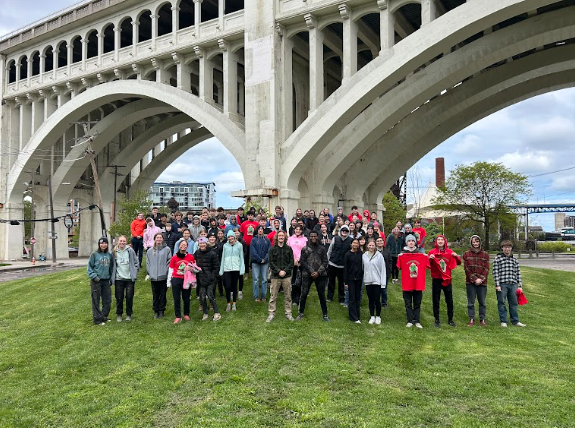
For students in particular, seeing original works offers something textbooks and screens cannot replicate. “I actually took Humanities last year, and we spent a lot of the year learning about different artworks before visiting the Cleveland Art Museum at the end of the year,” Soeder said. “Getting to see some of the same pieces in person was such a huge difference. The size, color, texture, it just added to the overall viewing experience.”
Williams, says that is exactly what she wants to see happen. “I can say that students who go on the Humanities field trip to the museum write in their portfolios how unique it is to see the paintings and sculptures in person,” she said. “They see the texture of the paint, the size and scope of the work, the timeline through the museum… Nothing can replace the experience of seeing it in person. And when we go, the students have learned about the periods of art and have a lot of information that makes it even more special.”
The museum also holds special exhibitions such as the upcoming Manet & Morisot exhibition from March 29 – July 5, 2026 is ticketed at $17-$25, and it is the first major exhibition to focus on the artistic connection between Édouard Manet and Berthe Morisot. The exhibition will showcase 36 paintings and six drawings that illustrate their fifteen-year-long friendship, which ranged from beach and garden scenes to portraits of Parisian women. The exhibition ends with a self-portrait of Morisot, celebrating her identity as a professional artist.

Antonio Canova
Location: 200 Rotunda
Not all special exhibitions charge a viewing fee. Pintoricchio Magnified, for example, provides a free digital immersive experience allowing visitors to step into the museum’s conservation studio. Using giant digital screens, guests can explore the layers of Pintoricchio’s Virgin and Child (c. 1490–1500), peeling back centuries of old paint and to reveal the materials and techniques that brought the work to life. Such experiences prove that even the most modern and behind-the-scenes exhibitions can still be enjoyed by the public.
Beyond its galleries, the museum offers events and performances to complement the art. Highlights include Date Night Performances: Tasting Notes, chamber music in the atrium by Oberlin Danenberg Honors Recitals, and thematic tours like Art and the Olympic Spirit. All upcoming events can be found at clevelandart.org/performing-arts with detailed information about each occasion. Visitors can round out their visit with a meal at Provenance restaurant, coffee at the café, or a stop at the museum store.
Andrew Hansen, an art teacher, emphasizes the museum’s broader significance. “I have a very high opinion of the museum. I’ve been to art museums all over the world, the Louvre, the Uffizi, and our Museum of Art holds a candle to those museums, not only in the collection, but in the exhibits, the architecture, the atmosphere, and the staff. We have a world-class museum.”

Greece, Alexandria, Hellenistic
Location: 102C Greek
He also highlights the museum’s educational and interactive opportunities. “They have a great community outreach staff. You can take classes, small workshops, free draws. It’s great for people seeking an interactive experience and some education as opposed to just being a casual visitor.”
On the topic of free admission, Hansen adds with enthusiasm. “It’s a gift of the Lord Santa Claus that it’s free, because most museums are not. And we have a great museum that happens to be free, only 20 minutes away. Anybody who hasn’t been there, go!”
In a cultural landscape where art is often framed as elite, the Cleveland Museum of Art offers a different approach. By keeping its permanent collection free and offering a mix of paid and free exhibitions and programs, the museum balances accessibility with ambition. It redefines who art is for, making creativity and human expression available to everyone.
Not occasionally. Not selectively. Always.