







































During the pinnacle of the Jim Crow era, Claudette Colvin and Max Robinson defied authority and racism in profound ways. The stories of a woman who refused to give up her seat nine months before Rosa Parks and a man who opened the door for millions of Black journalists were undermined by public personas. Today, their names may not be widely known, but their actions have given African Americans a voice and inspired those who have heard their stories in America and around the world.
Black History Month at BBHHS
For many, Black History Month is a time to reflect and honor the activism, culture, and impacts made by African Americans throughout history. This education happens through community events, celebrations, and parades that recognize influential activists and culture. At BBHHS, the social studies department teaches students about a great deal of Black history year round in its curriculum. Elizabeth Mieskowski, social studies department head, comments, “Well, as a department, we commemorate the month, but really, we talk about contributions of different groups, all throughout our curriculum, and so even though we celebrate it and we talk about it in class, it’s really something that we try to infuse in our courses all throughout the school year.”
Sophomores Peyton Williams and Alexandra Jaegers both express concerns with the recognition outside of the classroom environment. Jaegers suggests that a segment on the morning announcements could be beneficial.
Kelli Izzo, BBHHS assistant principal, provides a unique perspective to the issue, voicing, “I feel like we need to do way more than what we do, because we want to reflect our students and I would love to have a student voice and have students share with us ways that they want to celebrate black history.” She highlights the importance of recognizing African American contributions throughout the year, instead of just February, but explains that the only way to achieve this is student initiative.
Claudette Colvin
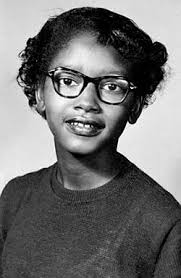
On September 5, 1939 in Birmingham, Alabama, Claudette Austin(now Claudette Colvin) was born to Mary Jane Gadson and C.P. Austin. After their father’s departure, Colvin and her sister were taken in by their great aunt and uncle, because Gadson was no longer able financially to support them. The girls considered Mary Anne and Q.P. Colvin true family, and adopted their last name around this time. The household relocated to Montgomery, Alabama, when Colvin was eight and five years later her sister tragically lost her life to polio just two days before Colvin’s thirteenth birthday. The news devastated Colvin and she found herself struggling in her classes and connecting with her peers due to immense grief at Booker T. Washington High School. She eventually recovered, joining the National Association for the Advancement of Colored People (NAACP) where she developed a connection with her mentor, Rosa Parks.
According to Wikipedia, on March 2, 1955, a fifteen-year-old-Colvin was on her way home from school, seated in the middle of a bus near an emergency exit, when the space quickly filled with Black passengers. Meanwhile, a white woman was standing on the left side of the vehicle looking for a seat in the front. The driver, Robert W. Cleere, instructed Colvin and three other Black women to move a row back. The three ladies obliged, but Colvin remained seated as a pregnant woman, Ruth Hamilton, had sat down next to her. Hamilton protested the driver’s command stating that she was too fatigued to move and she had paid for a spot on the bus.
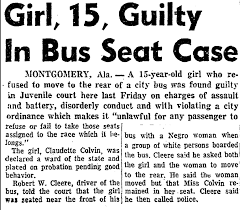
Once again, Cleere ordered for Colvin and Hamilton to move, this time alerting police officers who were able to open up a new resting spot for the two women. Hamilton moved to the new seat, but Colvin refused to stir. She later explained in an interview that “history kept me stuck to my seat. I felt the hand of Harriet Tubman pushing down on one shoulder and Sojourner Truth pushing down on the other”.
Encyclopedia of Alabama reports that Colvin had dreamed of becoming an attorney and was well aware of her Constitutional right to sit wherever she desired, and she was not afraid to let two officers know. Colvin’s classmate, Annie Larkins Price, recalled, “She had been yelling, ‘It’s my constitutional right!’. She decided on that day that she wasn’t going to move.”
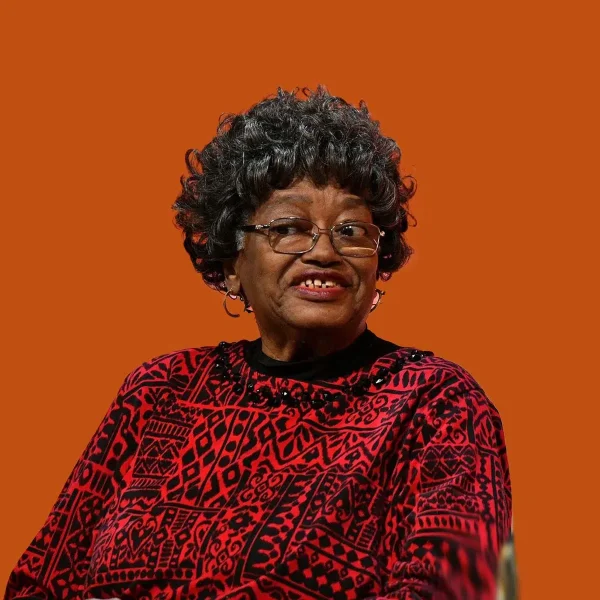
While she argued, the men hit her with their nightsticks, swore at her, eventually dragged her off the bus, handcuffed her, and took Colvin to the station. The abuse did not stop there, as the men continued to harass the young teen, making sexual comments about her breast size. During the car ride, Colvin was fearful that one of the officers would sexually assault her, as that was a frequent occurrence at the time for women of color.
She was convicted on three charges—disturbing the peace, violating segregation laws, battering/assaulting a police officer—two of which were later dropped in an appeal to the court. Colvin’s bravery inspired Parks, who historically refused to give her seat up to a white passenger nine months later.
A bus boycott long in the making considered Colvin as a potential face for the movement, but several factors including her appearance, age, and circumstances led to the role being held by Parks. Colvin stated, “My mother told me to be quiet about what I did. She told me: ‘Let Rosa be the one. White people aren’t going to bother Rosa[,] her skin is lighter than yours and they like her.’”
Colvin had darker skin, “bad hair”, was too young, and had gotten pregnant in the months following her arrest, making her a poor candidate for a position that needed to appeal to white conservatives.
Her actions did prove impactful a year later when Colvin participated as one of the four plaintiffs in the Browder v. Gayle federal court case. She testified her personal experience with racial prejudices in the Montgomery public transportation system alongside three Black women, Aurelia Browder, Susie McDonald, and Mary Louise Smith. Their testimonials were powerful, and the court ruled that segregation on buses was unconstitutional.
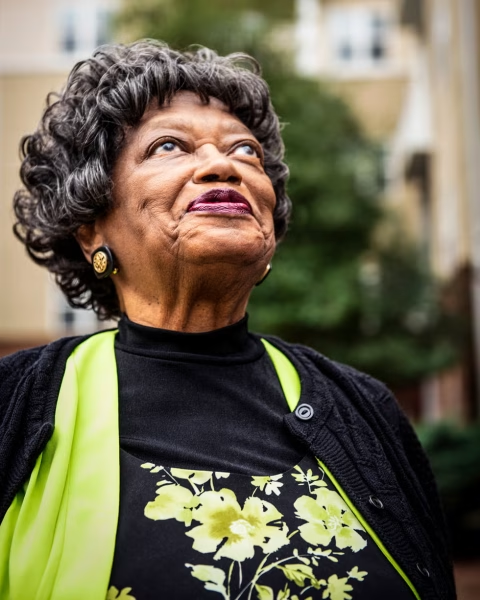
During the trial, Colvin gave birth to her first son, and shortly after left Montgomery for New York City. She sought a fresh start, as her efforts had labeled her a troublemaker in college and the community. Colvin died at the age of eight-six while in hospice care on January 13, 2026.
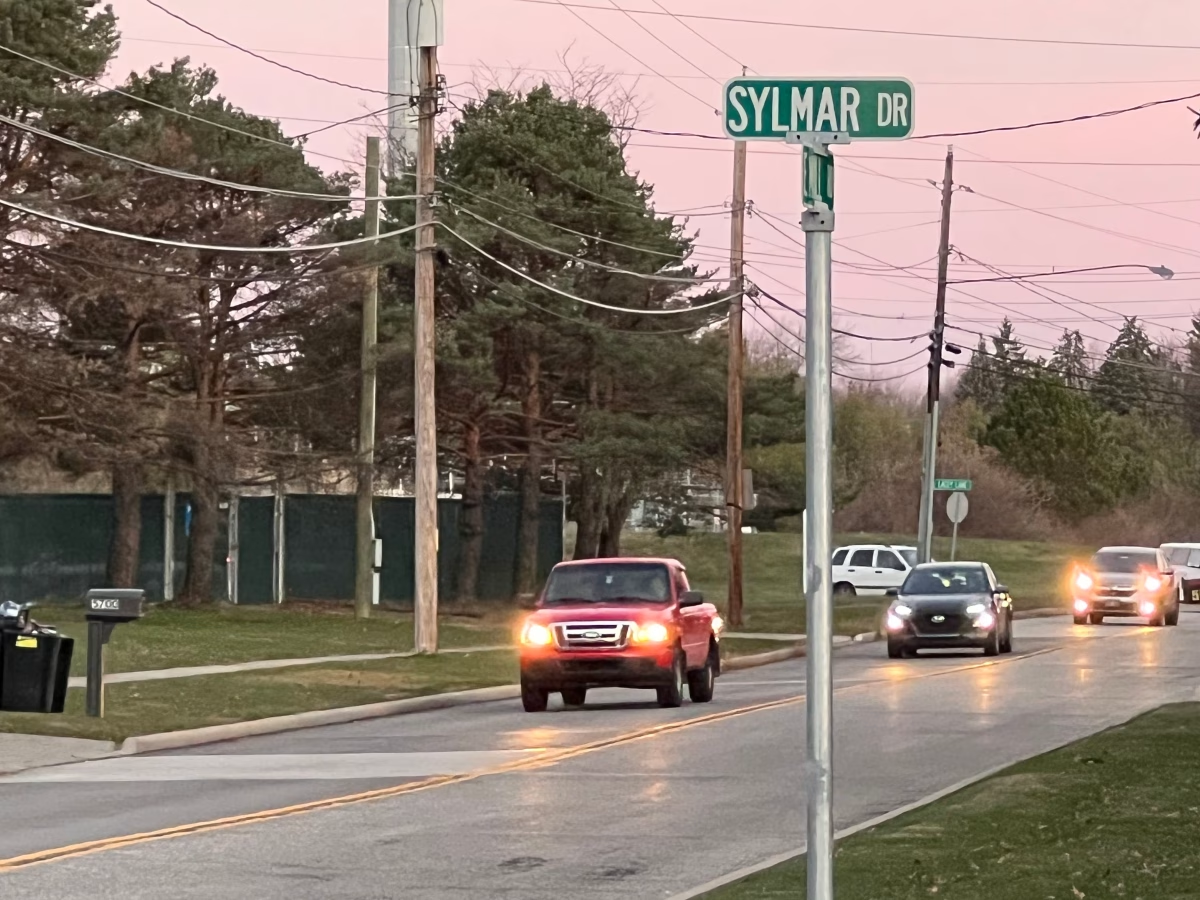
Although she has passed, her legacy still remains. In 2010, the street where she grew up was named Claudette Colvin Drive, and in 2021 a mural was hung there of Colvin. Her story continues to inspire, even at BBHHS. Junior Oluwapelumi Lawal explains, “I’m fifteen right now and she was willing to do something like that because again, during that time, if you didn’t give up your seat, you’d get socially harassed and you could get arrested. I don’t think I have that courage, so that was kind of inspiring.”
Max Robinson
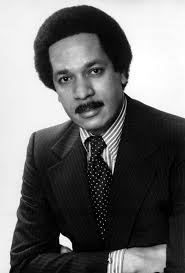
Maxie Cleveland Robinson Jr. was born on May 1, 1939 in Richmond Virginia to two teachers, Maxie Sr. and Doris Robinson. He attended segregated schools in Richmond where, according to EBSCO, his passion for public speaking surfaced at the age of fourteen. In his youth, he found jobs as an announcer on Black jazz radio stations.
After high school, Robinson attended Oberlin College on a scholarship given to high academic achievers, and was class president his freshman year. He paused his studies a year and a half into college to pursue an opportunity in television back in Virginia.
In no way did Robinson let the racism and injustice associated with the Jim Crow era halt his reporting ambitions. In 1959 he applied for a job at a television center in Portsmouth, Virginia. Out of thirty white male applicants, Robinson was chosen as the anchorman for weekend broadcasts at WTOV-TV. This opportunity was one of a kind as most news stations refused to hire any colored newscasters at the time, but the success came at a price. Robinson’s face had to be covered by the station’s logo while he was on screen. A Wikipedia article reported that Robinson became fed up with the unfair treatment and lack of recognition, so he intentionally removed their logo and was fired from his job.
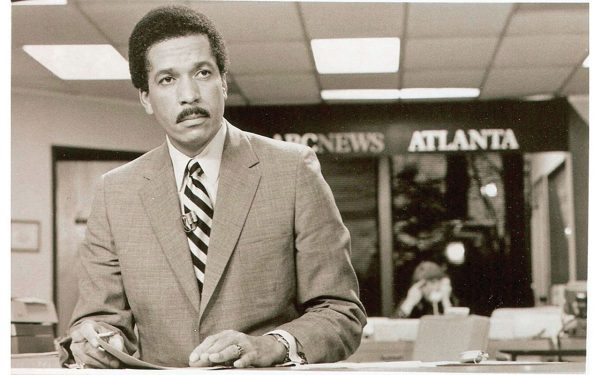
After the incident, Robinson joined the United States Air Force where he was trained to be a Russian language specialist at the University of Indiana. Due to his colorblindness, he was unable to fly an aircraft and was discharged early.
In the time following his release, Robinson made huge strides in his career as a part of WRC-TV. In the three years that he was with the station, Robinson won six journalism awards and two Emmys for his work reporting on the riots that followed Martin Luther King Junior’s death and his documentary titled The Other Washington.
He then joined WTOP-TV where he made history as the first African American to anchor a newscast in Washington D.C. alongside Gordon Peterson. In 1975, he and forty-three other men founded the National Association of Black Journalists (NABJ) and then he accepted the award of NABJ Journalist of the Year with Robert C. Maynard, editor of The Oakland Tribune, in 1981.
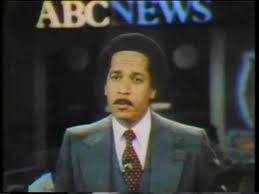
Robinson stayed with WTOP-TV for nine years in total before he was selected to co anchor ABC’s World News Tonight, making him the first Black man to anchor a nightly newscast. Robinson was at the height of his career when he received another Emmy award and recognition globally for his talent and authenticity on camera.
His charismatic personality was loved by audiences, but behind the scenes racism and discrimination prevailed. In 1981, Robinson gave a speech to students attending Smith College in Massachusetts about the warped view of the media. He emphasized the racial prejudices that were still present after the civil rights movement, but were not discussed in the reporting system which was centered around the white-American perspective. He remarked, “Only by talking about racism, by taking a personal risk, will I take myself out of the mean, racist trap all Black Americans find themselves in.”
He also dealt with more personal struggles like three failed marriages. Unfortunately, Robinson developed an alcohol addiction, impulsive behavior, and depression as a result of ever-present self esteem issues according to the Los Angeles Times. His coworkers reported that he would often show up late or skip work entirely due to his struggles. In 1983, he was demoted at ABC and as a result left to anchor for WMAQ-TV. Two years later, Robinson was fired and withdrew from the public eye entirely.
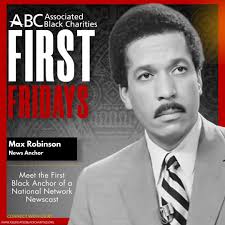
December 20, 1988, at the age of forty-nine, Robinson passed away due to acquired immune deficiency syndrome (AIDS). His passing brought attention towards the prevalence of AIDS among African Americans and highlighted the importance of preventative measures to avoid contracting the disease.
Although racism and discrimination took a toll on his mental health and career, Robinson laid the foundation for Black journalism and news casting in America. His rejection of white authority and unrelenting determination allowed him to break racial barriers and make history. Even today his inspirational story and his contagiously charismatic personality are remembered among Americans.
Izzo notes that Robinson’s story is a reminder of how fresh the Civil Rights Movement is in American history. “That [Max Robinson’s career] was not too long ago in our country’s history, if you think about it, but when we think about Black history and Black culture, we think that’s a long time, but it’s really not,” she explains.